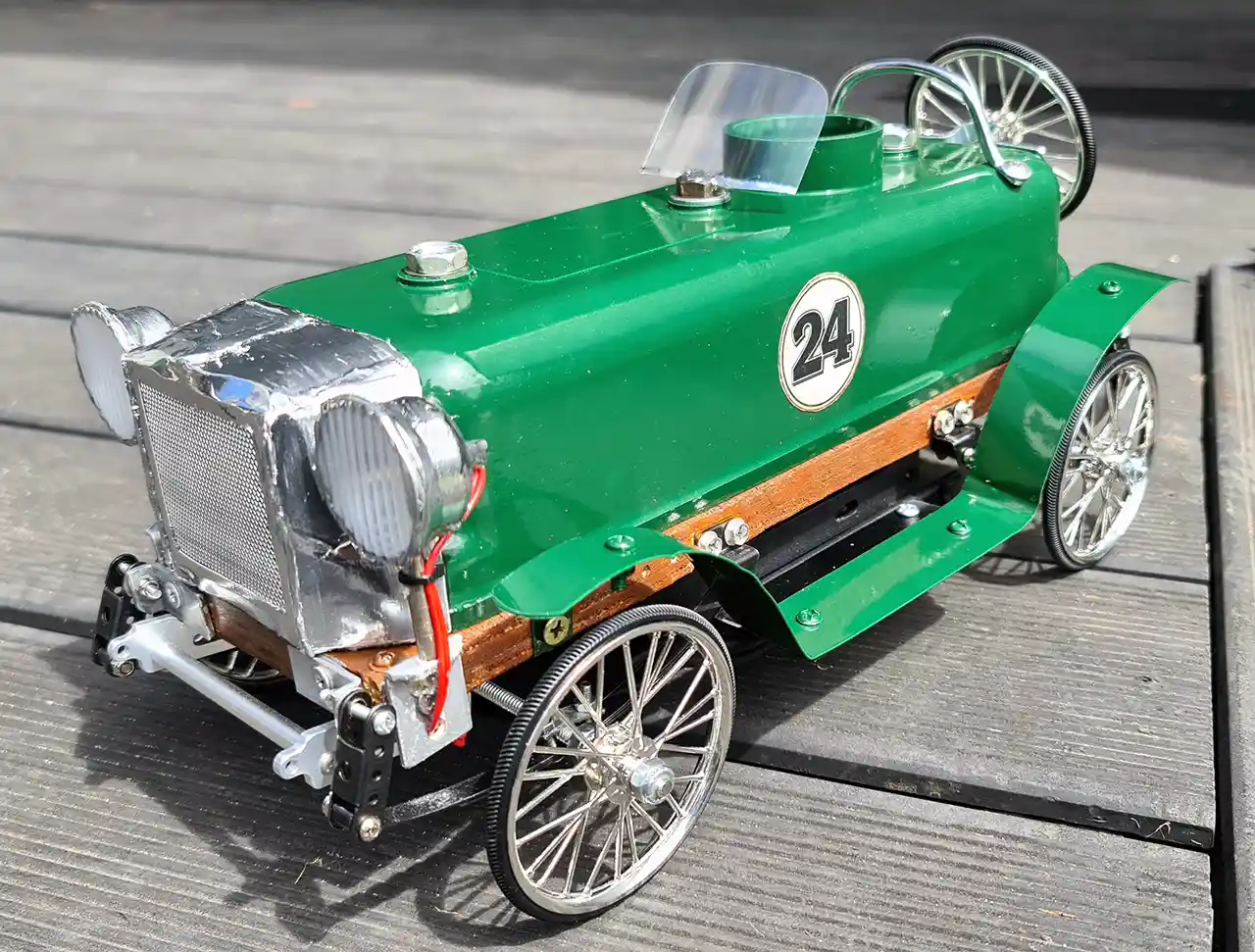
What is Rocker Cover
Racing?
Rocker cover racing
(also known as valve
cover racing) is a
gravity-powered
motorsport in which
participants build
miniature racers from
engine rocker covers and
send them down a sloped
track. Instead of
engines, fuel, or
drivers, these machines
rely entirely on
gravity, wheel
alignment, weight
distribution, and good
design to reach the
finish line first. The
racers are typically
built from real rocker
covers - the metal
covers that sit on top
of an internal
combustion engine and
enclose the rocker arms
and valve gear.
 At car shows and
motoring events,
competitors transform
these otherwise ordinary
engine parts into small
racing machines by
fitting wheels, axles,
and decorative elements.
While the basic
requirement is that the
vehicle must retain most
of the original rocker
cover and have no
mechanical propulsion,
creativity is
encouraged. Builders
often add paintwork,
scale drivers, spoilers,
weights, or themed
decorations to give
their racer a unique
appearance.
At car shows and
motoring events,
competitors transform
these otherwise ordinary
engine parts into small
racing machines by
fitting wheels, axles,
and decorative elements.
While the basic
requirement is that the
vehicle must retain most
of the original rocker
cover and have no
mechanical propulsion,
creativity is
encouraged. Builders
often add paintwork,
scale drivers, spoilers,
weights, or themed
decorations to give
their racer a unique
appearance.
Although the racers look
like miniature cars,
they operate more like
soapbox derby vehicles.
They roll down a ramp or
inclined track purely
under gravity, usually
in side-by-side lanes.
Once released, the
racers cannot be
steered, so success
depends on straight
tracking, low friction,
and careful weight
placement.
Where Did Rocker Cover
Racing Come From?
Rocker cover racing
emerged from the hot-rod
and custom car scene in
the United States during
the late 1980s. The
earliest widely
documented event was the
first "Valve Cover
Nationals" held in
1987 at the West Coast
Nationals hot-rod show
in Pleasanton,
California. The idea was
conceived by hot-rodding
enthusiast Gary
Meadors, founder of
the Goodguys Rod &
Custom Association,
during informal
discussions with fellow
car builders.
The concept was
deliberately simple:
create a fun,
inexpensive activity
that anyone attending
the car show could
participate in. By using
discarded engine parts
and a gravity-powered
ramp, participants could
compete without needing
expensive race cars or
specialised equipment.
The inaugural event
attracted more than 50
entries racing down a
24-foot ramp,
demonstrating that the
idea had instant appeal
among car enthusiasts.
The sport quickly spread
through the car-show
circuit. Automotive
clubs, hot-rod events,
and motoring festivals
began hosting their own
races as entertainment
for spectators and
participants alike.
Because the vehicles are
cheap to build and easy
to transport, rocker
cover racing became a
popular
family-friendly side
event at larger
automotive gatherings.
How the Racing Works
 Although the racers resemble miniature cars, rocker cover
racing is closer to a soapbox derby. Each racer rolls down a sloped
track powered only by gravity.
Although the racers resemble miniature cars, rocker cover
racing is closer to a soapbox derby. Each racer rolls down a sloped
track powered only by gravity.
Most races take place on a two-lane track consisting of a
ramp followed by a flat section. Competitors place their racers at the starting
line, and when the gate drops, gravity does the rest. The first racer to cross
the finish line wins the heat.
Typical Rules
While rules vary between
events, most rocker
cover races share
several common features:
🏁 Gravity-powered:
Racers must have no
motors, springs, or
propulsion systems.
Gravity provides the
only power.
🏁 Original rocker
cover base: Most
rule sets require the
vehicle to retain a
majority of the original
rocker cover so it
remains recognisable as
an engine part.
🏁 Wheel-based
design: Builders add
small wheels and axles -
often from roller
skates, model cars, or
similar hardware.
🏁 Weight and size
limits: Many
competitions set maximum
dimensions or weight to
keep the vehicles
comparable.
🏁 Two-lane tracks:
Racers are typically
released simultaneously
down parallel lanes on a
ramp followed by a flat
section, with the first
to cross the finish line
winning the heat.
Events often include
several categories, such
as fastest racer,
best engineering, or
best-looking vehicle,
reflecting the sport's
combination of
engineering challenge
and creative expression.
Creativity Encouraged
While speed is important, creativity is also a big part of
the sport. Many competitors decorate their racers with paint, miniature drivers,
sponsor decals, wings, or themed designs.
Some racers resemble tiny hot rods or dragsters, while
others take on humorous themes or elaborate custom builds. Because of this, many
events include prizes not only for the fastest racer, but also for categories
such as Best Engineering, Best Presentation,
or Most Original Design.
Why It's Popular
Rocker cover racing has become a favourite attraction at car
shows and club events because it combines engineering, creativity, and friendly
competition. The racers are inexpensive to build, easy to transport, and
suitable for participants of all ages.
Perhaps most importantly, it captures the playful spirit of
automotive enthusiasm: taking an everyday engine part and turning it into
something fun, inventive, and a little bit ridiculous.
Culture and Appeal
 Part
of rocker cover racing's
charm lies in its
playful spirit. It
blends the engineering
tinkering of motorsport
with the artistic
creativity of model
building. Many racers
are themed - replicas of
hot rods, dragsters,
cartoon cars, or even
humorous designs
featuring miniature
drivers or exaggerated
bodywork.
Part
of rocker cover racing's
charm lies in its
playful spirit. It
blends the engineering
tinkering of motorsport
with the artistic
creativity of model
building. Many racers
are themed - replicas of
hot rods, dragsters,
cartoon cars, or even
humorous designs
featuring miniature
drivers or exaggerated
bodywork.
The sport also reflects
a long tradition within
automotive culture of
turning everyday
mechanical parts into
something entertaining.
By transforming
discarded engine
components into racing
machines, enthusiasts
celebrate the mechanical
heritage of the
internal-combustion
engine while engaging in
a light-hearted
competition.
Today rocker cover
racing can be found at
classic car shows,
hot-rod festivals,
automotive club meets,
and charity events
around the world.
Despite its simplicity,
it continues to draw
crowds thanks to its mix
of speed, creativity,
and friendly rivalry.
Get Involved
If you enjoy building things, tinkering with mechanical
parts, or simply having a bit of fun at a car show, rocker cover racing is a
great way to get involved. Whether you build the fastest machine on the track or
simply the most entertaining design, it's all about creativity, ingenuity, and
enjoying the event.
Rocker Cover Racing is now a
permanent fixture at Mid Coast Motorfest, our Club's flagship event.
 Click here to learn more.